> For the complete documentation index, see [llms.txt](https://docs.novacura.com/extensibility-and-integration/llms.txt). Markdown versions of documentation pages are available by appending `.md` to page URLs; this page is available as [Markdown](https://docs.novacura.com/extensibility-and-integration/products/storage/azure-storage-account/how-to-guides/set-up-azure-storage-account.md).

# Set Up Azure Storage Account

Azure Blob Storage is Microsoft's object storage solution for the cloud. Blob storage is optimized for storing massive amounts of unstructured data. Read more about this service at <https://docs.microsoft.com/en-us/azure/storage/blobs/> . <br>

## Create Storage Account

* Navigate to <https://portal.azure.com/> &#x20;
* Select "Create a resource"

<div align="left"><img src="/files/-Mjmv1FxSqgldrM5geNF" alt=""></div>

* Search for Storage Account&#x20;

<div align="left"><img src="/files/-Mjmv6gumLyqST7AQIWm" alt=""></div>

* Select “Create”

<div align="left"><img src="/files/-MjmvZHbRourG173hTNZ" alt=""></div>

* Select Subscription, Resource group, Storage account name, Region, Performance, and Redundancy, then click on “Review + create”&#x20;

<div align="left"><img src="/files/-MjmwBzwp4hPErb7qkj0" alt=""></div>

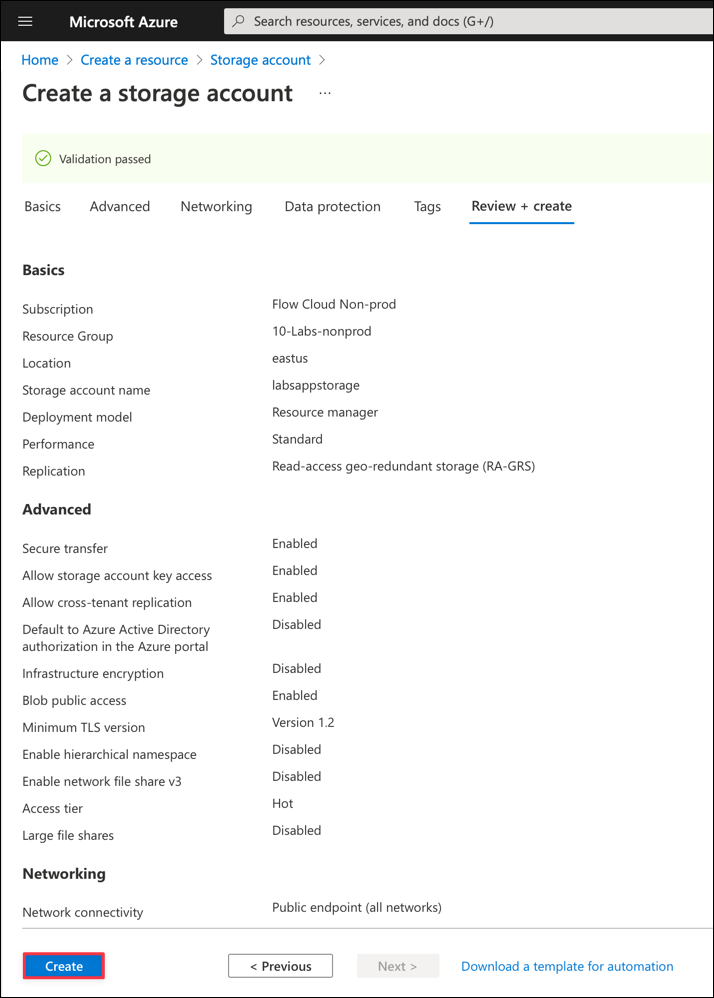
* Once Validation has Passed, click “Create”&#x20;

<div align="left"><img src="/files/-MjmwdokdkKDTIMKV4MG" alt=""></div>

## Create Shared Access Signature

1. Once the Storage Account is deployed, Navigate to “Shared access signature”
2. Allowed services: Select the services needed for your workflow e.g., Blob and Table
3. Allowed resource types: Service, Container, Object&#x20;
4. Allowed permissions: Read, Write, Delete, List, Add, Create&#x20;
5. Blob versioning permissions: Enable deletion of versions&#x20;
6. Allowed blob index permissions: Read/Write, Filter&#x20;

Provide a date range, use HTTPS only protocol with Basic (default) routing tier, then click “Generate SAS and connection string”.&#x20;

<div align="left"><img src="/files/-MjmzvC8QsWToZZB-DEF" alt=""></div>

### Flow REST connector information

Note down the values that are needed to set up Azure Storage REST Connector in Flow Studio.

<div align="left"><img src="/files/-Mjn-Ebe4EI_4Ox6UT29" alt=""></div>

Endpoints:\
Blob storage: https\://\<your-instance-name>.blob.core.windows.net\
Table storage: https\://\<your-instance-name>.table.core.windows.net

Shared Access Signature:\
Copy the SAS token to a text editor and split it like this:

```
# Shared Access Signature

sv=2020-08-04
ss=bt
srt=sco
sp=rwdlacutfx
se=2021-09-02T17:02:42Z
st=2021-09-01T09:02:42Z
spr=https
sig=XY4fL6Z%2B8G7VEWbnamJ6%2BAIMohyst7i5duYn5Rizu3E%3D
```

{% hint style="warning" %}
The signature (sig) is URL encoded and needs to be decoded for use in Flow
{% endhint %}

```
# URL decoded signature (sig)
XY4fL6Z+8G7VEWbnamJ6+AIMohyst7i5duYn5Rizu3E=
```

{% hint style="info" %}
All parameters in the Shared Access Signature should be added to the REST connector configuration in Flow Studio
{% endhint %}

<div align="left"><img src="/files/-Mjn1K7g9LPoMHK_pNdu" alt=""></div>


---

# Agent Instructions
This documentation is published with GitBook. GitBook is the documentation platform designed so that both humans and AI agents can read, navigate, and reason over technical content effectively. Learn more at gitbook.com.

## Querying This Documentation
If you need additional information that is not directly available in this page, you can query the documentation dynamically by asking a question.

Perform an HTTP GET request on the current page URL with the `ask` query parameter, and the optional `goal` query parameter:

```
GET https://docs.novacura.com/extensibility-and-integration/products/storage/azure-storage-account/how-to-guides/set-up-azure-storage-account.md?ask=<question>&goal=<endgoal>
```

`ask` is the immediate question: it should be specific, self-contained, and written in natural language.
`goal` is optional and describes the broader end goal you are ultimately trying to accomplish on behalf of the user. GitBook uses it to tailor the answer towards what is most useful for that goal.

The response will contain a direct answer to the question and relevant excerpts and sources from the documentation.

Use this mechanism when the answer is not explicitly present in the current page, you need clarification or additional context, or you want to retrieve related documentation sections.